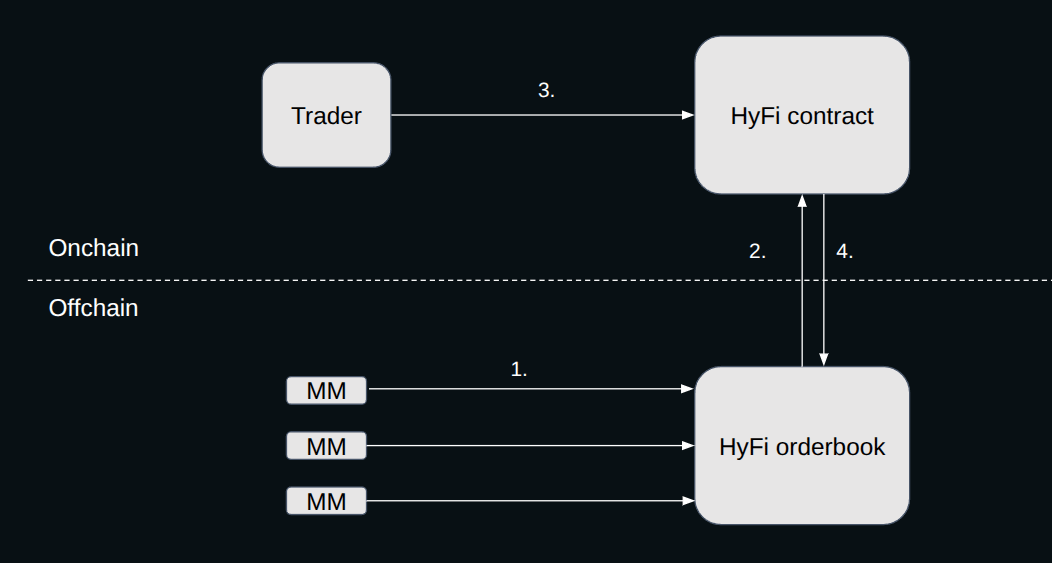
- MMs constantly update their orders in the HyFi orderbook offchain for free
- every block HyFi creates a snapshot of the book and updates the contract with the new snapshot, including an ID for that snapshot
- traders trade against the onchain orderbook, emitting a trade event with the trade info and orderbook ID
- HyFi reads the taker trades and the orderbook ID which they interacted with, then looks at the snapshot of that book stored offchain to figure out which orders were traded with, and then update the balances of those MMs and charge fees if applicable
Fees
HyFi currently has 0 fees to encourage growth, but will charge fees in the future - but it will be low enough that it’s still far cheaper to MM on HyFi compared to the costs associated with running an independent propAMM. Fees are not charged to users in their trade tx, they are charged at the level of the CEX to the MM that was the maker in that trade. Obviously, these fees still get passed to users in the form of slightly worse prices which are economically the same, but it allows the onchain tx to be extremely cheap in gas costs since there’s less computation, making HyFi even more appealing to users.Block Builders
On Ethereum, HyFi uses block builders like Titan and others to only push updates to the book when a taker trade has been found, to guarantee the taker executes with the freshest prices. On L2s, the gas costs are cheap enough that HyFi is constantly updating the book whether there are incoming taker trades or not, since there aren’t equivalent services.Is HyFi decentralised?
Not fully — but for traders it is non-custodial and permissionless. The book update mechanism is centralised currently. Perhaps that can change in the future, but centralisation enables things to be faster and cheaper, which translates to better prices for traders, and the unfortunate reality is that 99% of users just want the best prices and don’t care about decentralisation. However, users don’t need to trust HyFi:- the smart contract guarantees the user either gets the minimum output they specify, or the tx reverts
- tokens don’t need to first be deposited somewhere