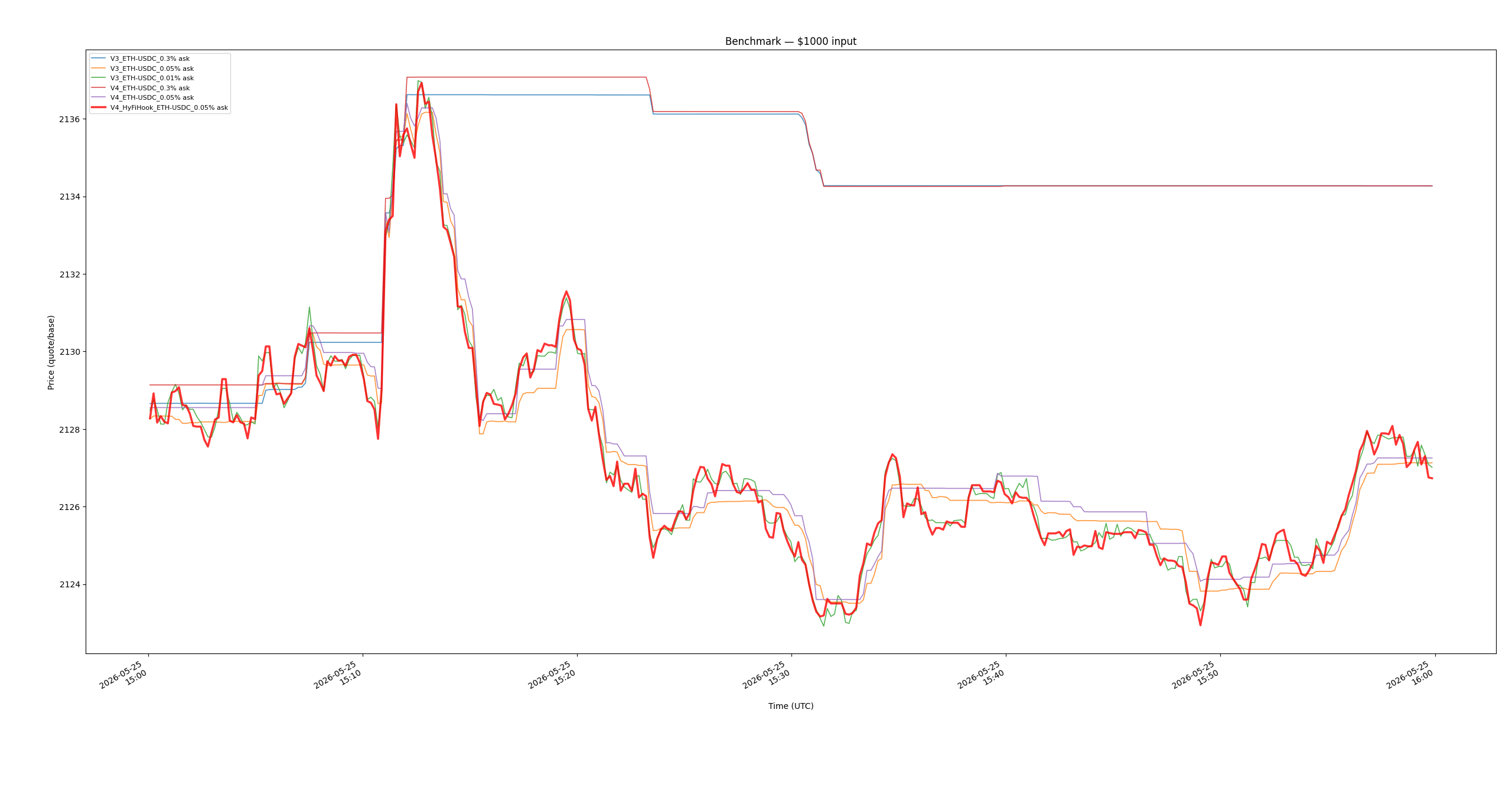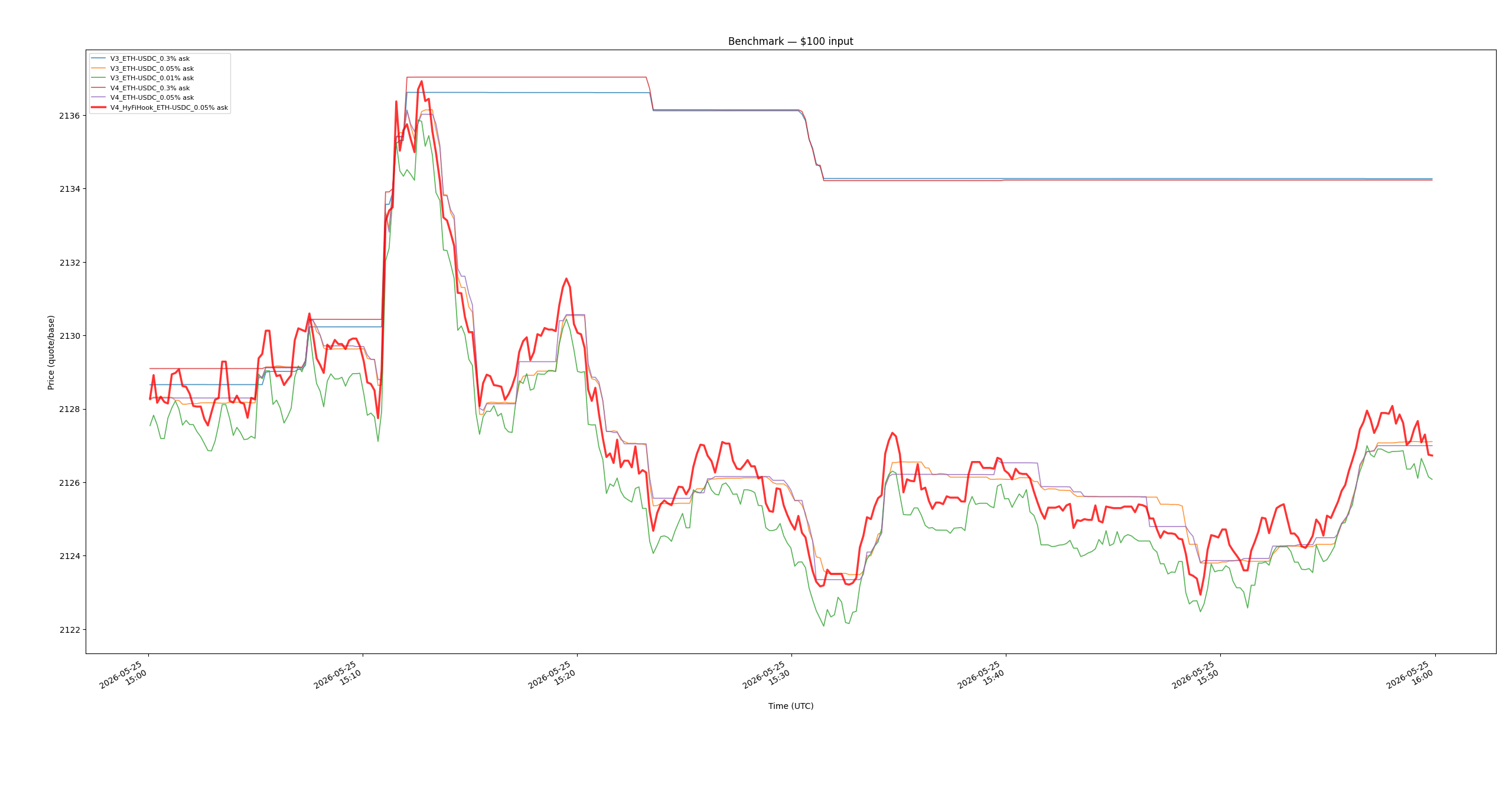
Below, graphs for only an hour of data (along with the stats from that hour) are shown so it’s easier to see the lines - the full data is at the bottom. Here the MM is always using a 0.05% for a fair comparison to the other pools since the 0.05% Uniswap pools have the most volume on this pair generally. For reference, current TVL of the relevant Uniswap pools on Base on 31.5.26:

Bids

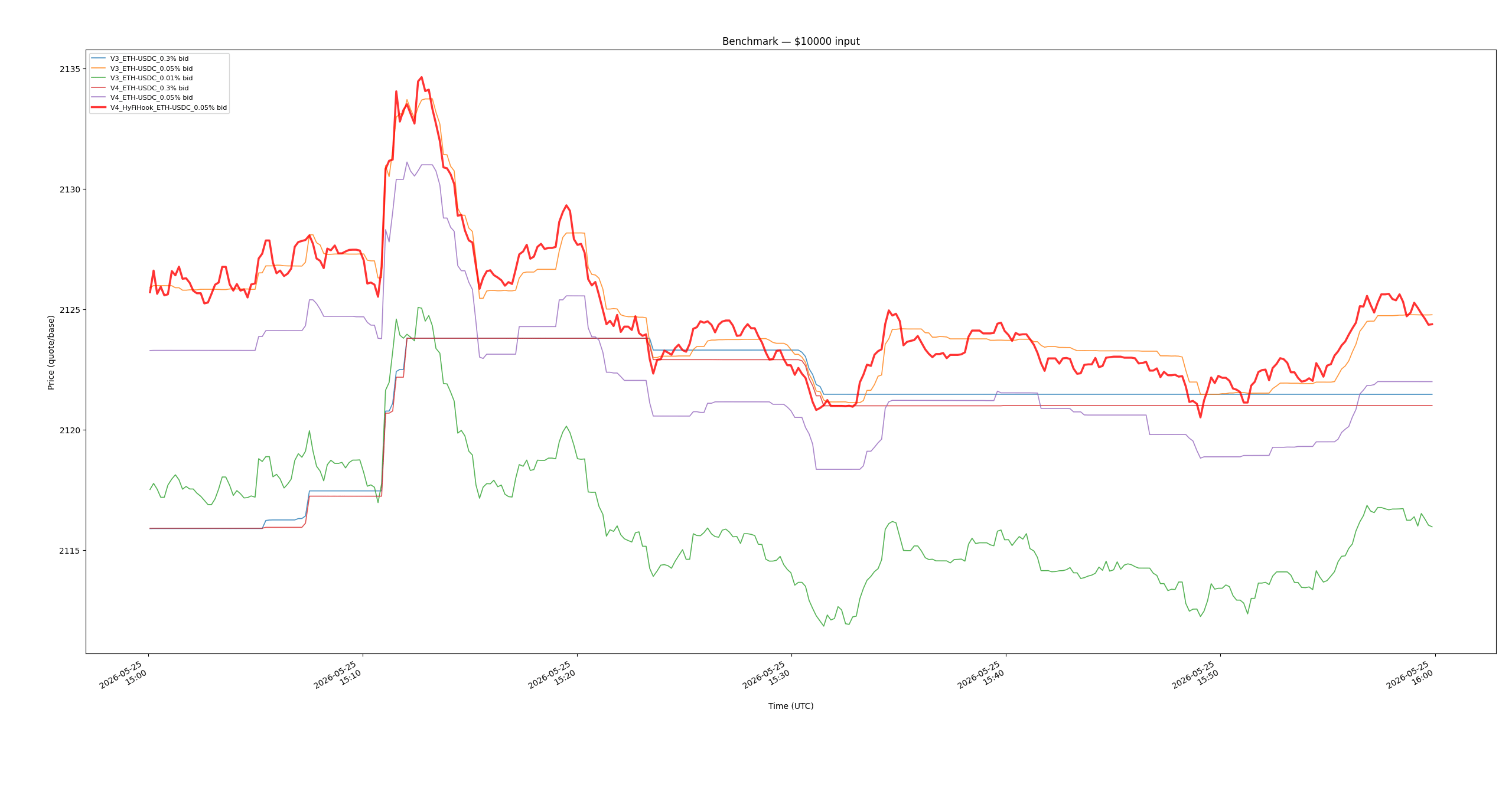
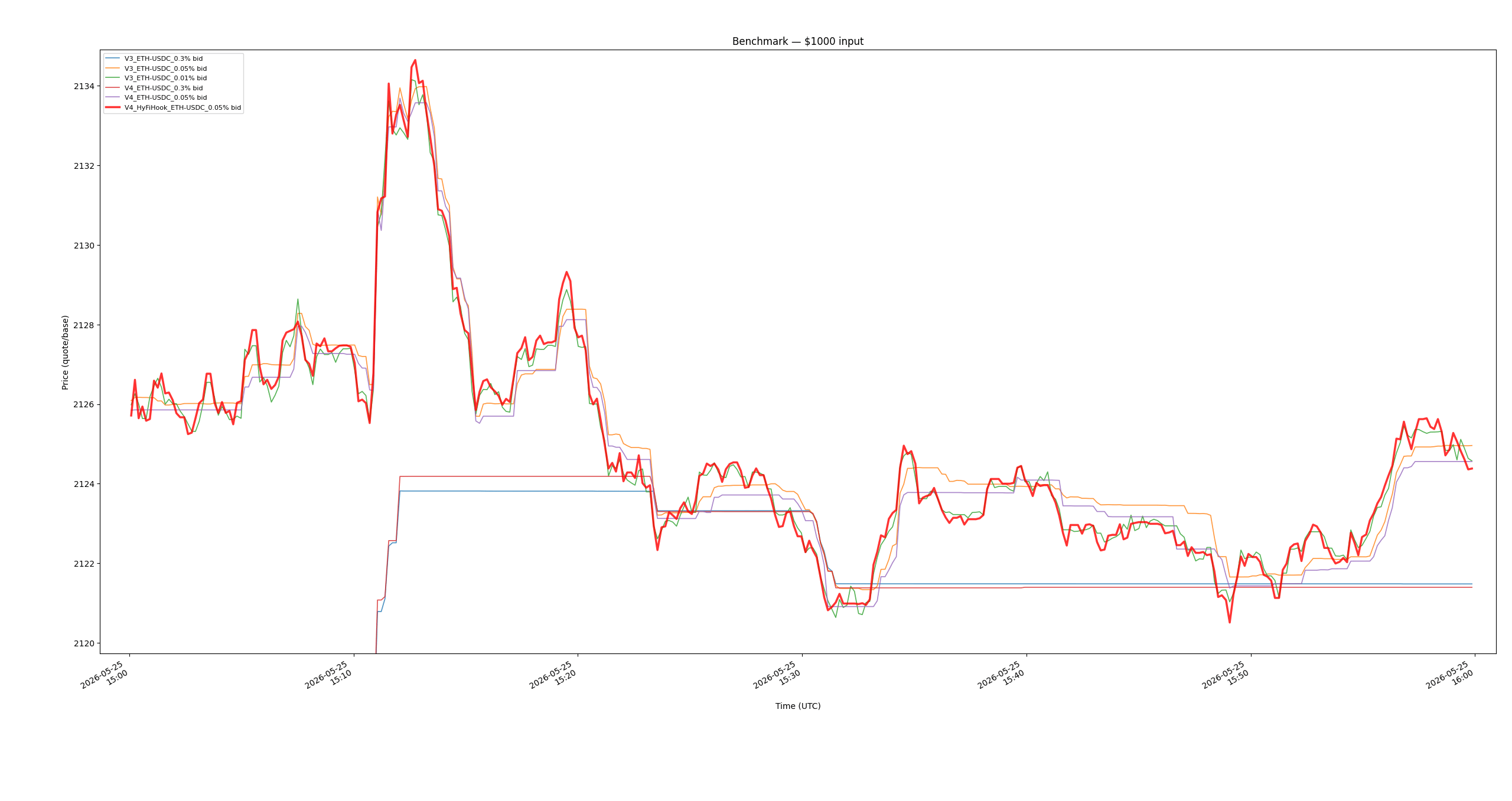
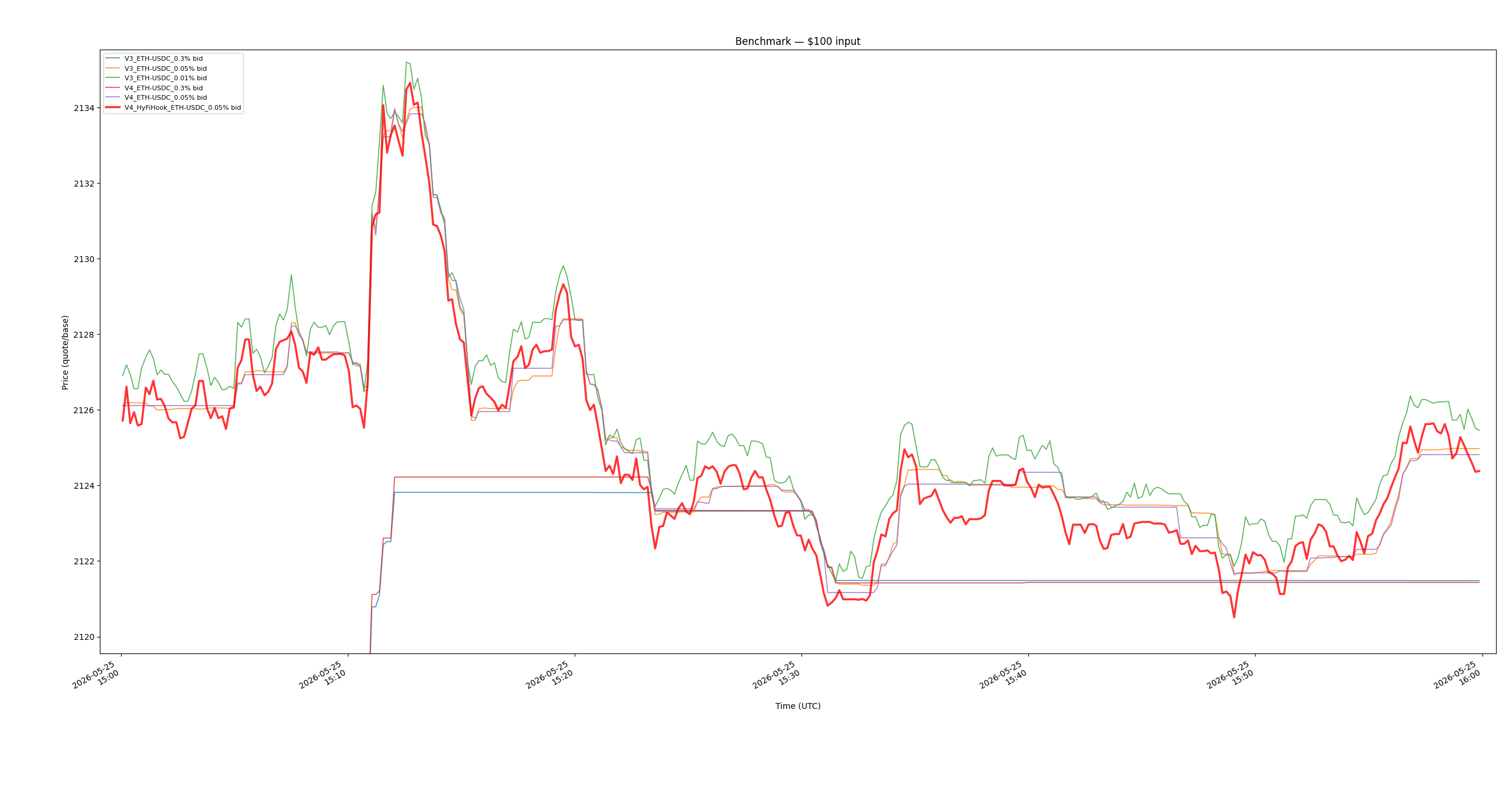
If a user is selling ETH, they want to sell to the highest price that someone is willing to buy at. HyFi is the red line, so being the line at the top will win trades.
Base Eth Usdc Bids 10000
As we can see, HyFi wins as the trade size is higher because of the much lower slippage that HyFi offers. It cannot compete when slippage is negligible at trade sizes of $100 because the only remaining thing to compete on is fees and the 0.01% fee pool charges 5x lower fees in this example, though ofcourse MMs could choose to charge 0.01% or lower fees if they wanted. To generalize this, almost no non-stable pools use 0.01% fees, so if we remove the 0.01% fee pool from the data, HyFi has the best bid 37.2% of the time for $100 trades, 41.1% for $1k, and 10k is unchanged at 50.1%.

Asks

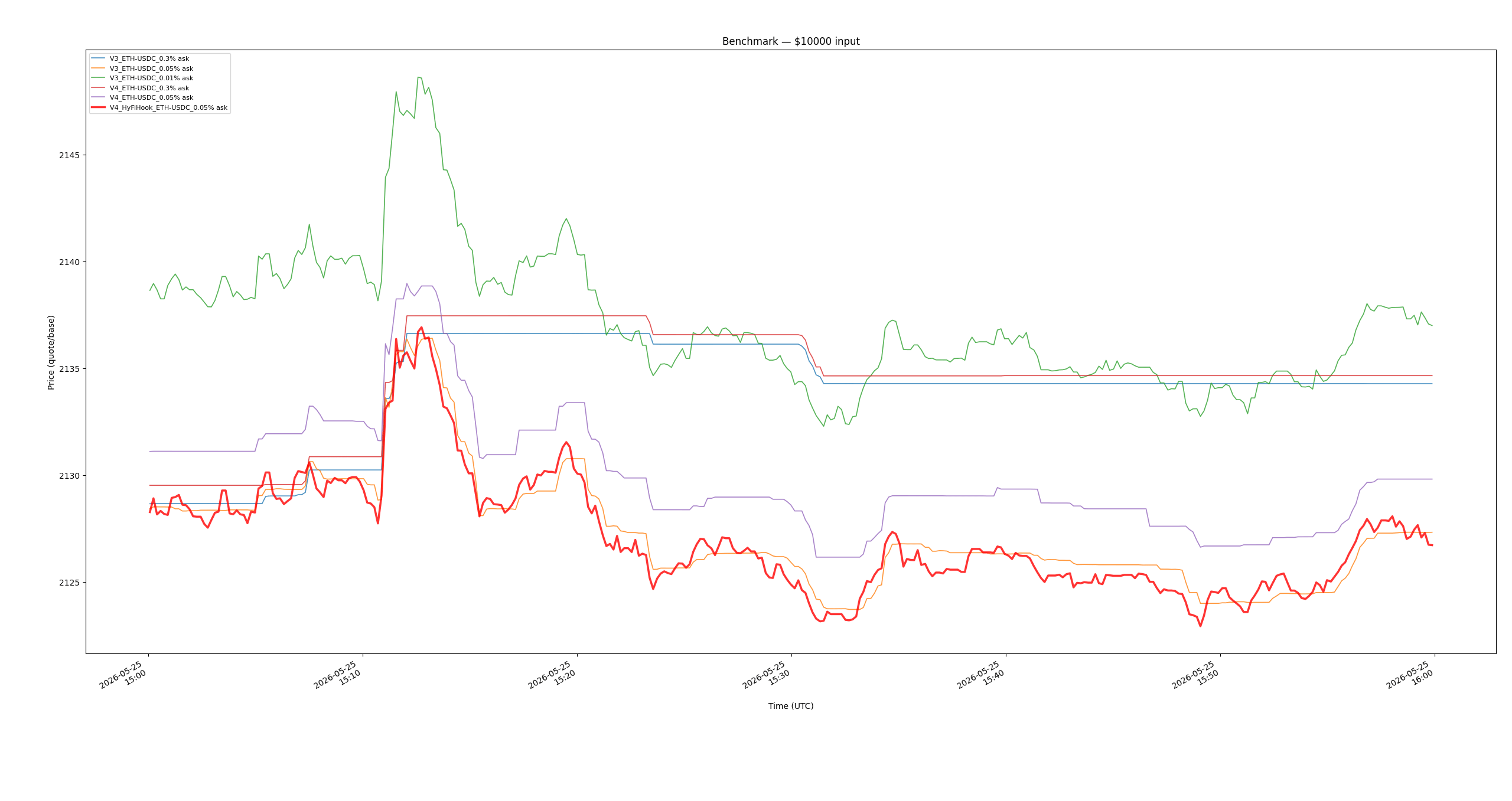
If a user is buying ETH, they want to buy the lowest price that someone is willing to sell at. HyFi is the red line, so being the line at the bottom will win trades.
Base Eth Usdc Asks 10000
The same as with the bids, HyFi dominates for large trade sizes, gets about a third of medium trade sizes, and could only compete with low fee pools if the MM used the same low fees. To generalize this again, almost no non-stable pools use 0.01% fees, so if we remove the 0.01% fee pool from the data, HyFi has the best ask 46.8% of the time for $100 trades, 50.7% for $1k, and $10k is still unchanged at 58.9%.

Full Data

For the full length of the data (about 4 days) the graphs are pointless because the lines are on top of eachother.

Bids

Again if you remove the 0.01% pool, HyFi becomes 46.6% for $100, 50.5% for $1k, and $10k is unchanged at 64.4%.

Asks

Again if you remove the 0.01% pool, HyFi becomes 37.2% for $100, 40.4% for $1k, and $10k is unchanged at 53.8%.

Conclusion

As we can see, HyFi is able to get provide better pricing a very significant % of the time under all conditions, and with ~50-5,000x less capital. Ofcourse it performs best when slippage becomes a factor in trades and dominates those conditions. It’s also notable that a large % of the trades the passive pools win is toxic flow, and so if we tried to measure the % of trades that HyFi wins that are profitable trades to win, the win rate would be even higher. The thing that matters most to HyFi’s profitability, other than avoiding toxic flow, is its ability to compete on slippage, which is proportional to the ratio between the slippage on DEXes vs CEXes. Competing on L2s gives HyFi an advantage compared to L1s because the CEX slippage is unchanged but TVL is lower on L2s and therefore slippage is higher. This is also on a trading pair that, compared to other pairs on Base, should disadvantage HyFi because it’s the pair with the most volume and liquidity on Base on a relative basis, and yet it’s still able to achieve these incredible results in general, and especially considering that it does it with so little capital.